How Does Affirm Work? APR, Limits & When to Use It (2026)
Affirm is not a Pay in 4 app — it's an installment loan product. Understanding that distinction is the difference between using it correctly and paying unexpected interest. Here's the full picture.
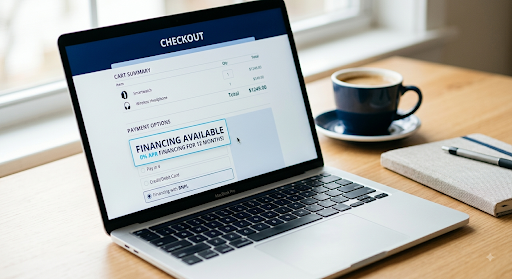
What Is Affirm?
Affirm is built around one thing that separates it from every other major BNPL app: it charges zero late fees, ever. The tradeoff is that it may charge interest — 0% to 36% APR depending on your credit and the retailer. Most of the confusion around Affirm comes from not understanding which of those two outcomes you're getting.
Affirm was founded in 2012 by Max Levchin (a PayPal co-founder) and operates as a licensed lender in the US. Unlike Afterpay or Klarna, which partner with merchants as payment processors, Affirm is actually issuing you a short-term personal loan. That regulatory difference is why it may report to credit bureaus and why interest rules apply.
How Affirm Works — The Actual Mechanism
At checkout, Affirm runs a soft credit check and shows you available loan options. You see the exact loan amount, interest rate (including 0% if available), monthly payment, and total cost — before you confirm. No surprises after the fact.
Affirm runs a soft credit check (no score impact). You see available loan terms — 3, 6, 12, or longer months depending on the purchase amount and your profile.
Affirm shows you the exact monthly payment and total interest before you confirm. A $500 purchase at 0% for 6 months costs $500 total. The same purchase at 15% APR costs $541 total. You decide after seeing those numbers.
Payments are charged monthly — not biweekly like Afterpay or Klarna. This longer cadence is what makes Affirm more suitable for higher-ticket items with longer sell cycles.
Unlike every other major BNPL app, Affirm never charges late fees. It will report late payments to credit bureaus, which is a different (and potentially more serious) consequence — but no dollar fee is added.
Does Affirm Charge Interest?
This is the most important Affirm question and the one most BNPL comparisons get wrong. The answer is: it depends on where you're shopping.
| Scenario | APR | Example — $500 Purchase | Total Cost |
|---|---|---|---|
| 0% promo from merchant | 0% | 6 payments of $83.33 | $500.00 |
| Low credit risk, good history | 10% APR | 6 payments of $85.61 | $513.66 |
| Mid credit range | 20% APR | 6 payments of $88.10 | $528.60 |
| Higher risk profile | 36% APR | 6 payments of $93.33 | $559.98 |
Affirm Spending Limits
Affirm has the highest published limits of any major BNPL app — up to $30,000 on qualifying purchases at qualifying merchants. In practice, your approved amount depends on your credit profile and what you're buying.
- Typical approvals for new users: $500–$2,000 depending on credit history
- High-ticket approvals ($5,000–$30,000) available with strong credit at participating merchants
- Amount offered may vary by merchant — the same buyer may get different limits at Best Buy vs a small retailer
Does Affirm Affect Your Credit Score?
This is where Affirm differs most significantly from Afterpay and Klarna.
| Action | Affirm | Afterpay | Klarna Pay in 4 |
|---|---|---|---|
| Application check | Soft (usually) or Hard (some products) | Soft only | Soft only |
| On-time payments reported | Some loans → Experian | Not reported | Not reported |
| Late payments reported | Yes → Experian | May go to collections | May go to collections |
| Can build credit | Yes (if reported) | No | No |
Affirm vs Afterpay vs Klarna — Quick Decision
| Use case | Best choice | Why |
|---|---|---|
| Clearance buy under $200 | Afterpay | Simpler, no interest risk, biweekly aligns with fast sell cycles |
| Walmart buy $200–$500 | Klarna | Pay in 30 option, Walmart partnership, no preset cap |
| Electronics $500–$1,500 at 0% APR | Affirm | 0% promo + highest limits + no late fees |
| Appliances $1,500+ at 0% APR | Affirm | Only app with limits that support this purchase size |
| Any purchase with APR above 0% | Afterpay or Klarna | Interest cost eats into arbitrage margins |
Using Affirm for Amazon Inventory Funding
Affirm fits a specific slot in the BNPL arbitrage stack — high-ticket items where Afterpay and Klarna limits fall short, and where a 0% promotional offer is available.
- Best categories: Electronics (laptops, tablets, gaming consoles), power tools, small appliances, cameras. These have BSR movement and 20%+ margins when bought at clearance.
- Best retailers: Best Buy (frequent 0% Affirm offers), Walmart, Home Depot (tool clearance).
- Monthly installment advantage: Electronics often take 3–5 weeks to sell on Amazon FBA. A monthly payment structure is more forgiving than biweekly Pay in 4 for these longer cycles.
- Never use Affirm with APR above 0% for inventory
At 15% APR, a $500 inventory buy costs an extra $14 in interest. That's margin loss on a business you're trying to run profitably. - Check BSR carefully on electronics
Electronics have more volatile BSR than consumables — an item ranked 50,000 can drop to 500,000 in a week if a price war starts. Keepa price history check is non-negotiable before buying.
The Starter Kit ROI calculator includes a field for interest cost — so you can model Affirm purchases accurately before committing.
Get the Starter Kit — $37Frequently Asked Questions
Affirm charges 0% to 36% APR depending on your credit profile and the specific loan. Many major retailers offer 0% APR promotional financing through Affirm. If a 0% offer is not available, Affirm will show you the exact interest amount before you confirm — you always see the total cost upfront.
Affirm may run a soft or hard credit check depending on the loan product. Some Affirm loans are reported to credit bureaus (Experian), which means on-time payments can help build credit and missed payments can damage it. This is different from Afterpay and Klarna, which generally do not report payment history.
Affirm does not publish a fixed spending limit. Individual loan approvals go up to $30,000 on qualifying purchases with qualifying merchants. Your approved amount depends on your credit profile, the merchant, and the specific purchase amount.
For purchases under $200, Afterpay is simpler — Pay in 4, no interest, no hard credit check. For high-ticket items above $500 (electronics, appliances), Affirm is better — much higher limits, 0% promotional offers at many retailers, no late fees, and monthly installment structure that fits longer sell cycles.
Yes. Affirm is best for high-ticket inventory — electronics, appliances, tools — where the purchase size exceeds Afterpay or Klarna limits. The monthly installment structure gives a longer payment window than biweekly Pay in 4, which suits categories where Amazon sell cycles run 3–6 weeks.