How Does Afterpay Work? Pay in 4 Explained (Fees, Limits & Credit Impact)
Before you use Afterpay — whether for shopping or for funding inventory — there are things the checkout screen doesn't tell you. This guide covers all of it.
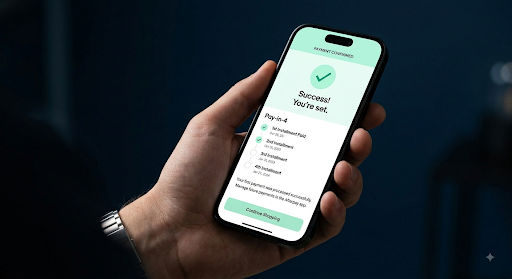
What Is Afterpay?
Afterpay is a buy now, pay later app that splits purchases into 4 equal interest-free payments — but understanding exactly how the Afterpay Pay in 4 system works, what triggers late fees, and what happens to your credit if something goes wrong is worth knowing before you use it.
Afterpay was founded in Australia in 2014 and is now one of the largest BNPL providers in the US, operating under Block, Inc. (formerly Square). It partners with thousands of retailers — from Walmart and Target to small online boutiques — and is available both online and in physical stores via the Afterpay Card.
How Afterpay Pay in 4 Works — Step by Step
Afterpay Pay in 4 always follows the same structure, regardless of purchase size. Here is the exact sequence on a $120 purchase:
You pay $30 immediately via your linked debit or credit card. Afterpay pays the retailer the full $120. You take the item home or it ships.
Afterpay automatically charges your card $30. No action needed. You receive a reminder notification 2 days before the charge.
Third installment. Same as above — automatic charge, 2-day reminder.
Last payment. You have now paid $120 over 6 weeks with zero interest or fees (assuming all payments cleared on time).
Afterpay Spending Limits Explained
Afterpay does not publish a fixed spending limit — which surprises most new users. Your available limit is calculated algorithmically based on your account history, payment behavior, and the specific purchase.
How limits work in practice
- New accounts typically start with a limit around $500–$600. The first purchase is often capped lower than subsequent ones.
- Limits increase automatically over time as you make on-time payments. Established users report limits of $1,500–$2,000+.
- The limit shown at checkout is your current available amount — not a permanent cap. It fluctuates based on your outstanding balance and payment history.
- Multiple open purchases reduce your available limit. If you have $400 in active Afterpay purchases, that amount is subtracted from your available limit for new orders.
Afterpay Late Fees — The Actual Numbers
Afterpay charges late fees when a scheduled payment fails. Understanding the exact fee structure matters before you use it for anything time-sensitive.
| Scenario | Fee Amount | Account Status | What to Do |
|---|---|---|---|
| First missed payment | $8 or 25% of installment (whichever is less) | Account paused — no new purchases | Pay overdue amount immediately to restore access |
| Payment missed for 7+ days | Additional fee up to the lesser of $8 or 25% | Account remains paused | Pay full overdue balance before account unlocks |
| Total fees per order | Capped at 25% of original order value | — | Afterpay will not charge fees exceeding 25% of the purchase |
| Sent to collections | Collection agency fees may apply | Potential credit impact | Pay before collections to avoid credit damage |
In practical terms: miss a payment on a $200 purchase and you owe $8 in fees (since $8 < 25% of $50 installment). Miss it on a $40 purchase and the fee is $10 ($10 = 25% of $40 installment), capped at $8 — so still $8. The fee structure is designed to be predictable.
Does Afterpay Affect Your Credit Score?
What Afterpay does NOT do
- Does not run a hard credit check at approval — only a soft inquiry
- Does not report on-time payments to Equifax, Experian, or TransUnion
- Does not appear on your credit report under normal usage
What Afterpay CAN do to your credit
- Collections reporting
If missed payments go unresolved, Afterpay may send the account to a collections agency. That collection account can appear on your credit report and cause significant score damage. - Soft inquiry on record
Afterpay's soft inquiry appears in your credit file (visible to you) but not in the hard inquiry section visible to lenders. Multiple BNPL applications in a short window can accumulate soft inquiries, though they carry no scoring weight.
Where Afterpay Is Accepted
Afterpay is accepted at thousands of online and physical retailers. For arbitrage purposes, the most relevant acceptance points are clearance-heavy retail chains.
Online and in-store via Afterpay Card
Online and in-store
Online and in-store
Online and in-store
Online
Does NOT accept Afterpay — use Klarna or Zip instead
Does NOT accept Afterpay
Does NOT accept Afterpay
Acceptance status is accurate as of 2026 and subject to change. Always verify at checkout or via the Afterpay merchant search at afterpay.com.
Afterpay Pros and Cons
Pros
- Zero interest if payments are on time
- Soft credit check only — no score impact
- Wide retail acceptance including Walmart and Target
- In-store use via Afterpay Card
- Predictable, capped late fee ($8 maximum)
- Early payoff allowed at no cost
- Fast approval — typically instant
Cons
- Non-transparent spending limits
- Account paused on first missed payment
- Lower limits than Affirm or Klarna for large buys
- Outstanding balances reduce available limit for new purchases
- No credit building — on-time payments not reported
- Not accepted at TJ Maxx, HomeGoods, or Costco
Using Afterpay for Inventory Funding
Beyond personal shopping, Afterpay is the most widely used BNPL app for retail arbitrage — the practice of buying clearance products and reselling them on Amazon or Walmart for profit. Here is why it works and what to watch for.
Why Afterpay fits the arbitrage model
- 25% down payment means you control 4x more inventory per dollar of available cash than buying outright.
- 14-day window to installment #2 aligns with Amazon FBA sell windows for fast-moving categories (toys, baby, health).
- Accepted at Walmart and Target — the two best clearance sourcing locations for Amazon arbitrage.
- Early payoff lets you clear the balance the moment your Amazon payout deposits, rather than waiting for the scheduled installments.
What to watch for when using Afterpay for inventory
- Slow-selling inventory creates payment pressure. If your items sit for 30+ days, installment #3 comes due before your payout. Always target BSR under 250,000 and verify with Keepa price history before buying.
- Stacking multiple inventory buys reduces your available limit faster. Start with one purchase, collect the payout, then scale.
Want the full system? The PayLaterProfit Starter Kit documents exactly how to use Afterpay as inventory funding — including the ROI calculator, payment timing guide, and sourcing tracker.
Get the Starter Kit — $37Real User Experience
r/FulfillmentByAmazon — "Afterpay at Walmart clearance is my main sourcing strategy now. I pay 25% at the store, ship same day to Amazon FBA, and by the time payment #2 hits, most of it has already sold. The $8 late fee cap makes it one of the safest BNPL apps to stack multiple buys with."
Community quotes sourced from public seller forums. Individual experiences — not guarantees of results. See our Earnings Disclaimer.
Frequently Asked Questions
Afterpay splits your purchase into 4 equal payments. You pay 25% at checkout; the remaining 3 payments are charged automatically every 2 weeks. There is no interest if all payments are made on time.
Afterpay does not disclose a fixed spending limit. New users typically start around $500–$600 and limits increase over time as you make on-time payments. Some established users report limits up to $2,000 or more. The limit shown at checkout is your current available amount.
Afterpay charges a late fee of $8 or 25% of the outstanding installment, whichever is less. Your account is paused — meaning you cannot make new purchases — until the overdue amount is paid. Persistent non-payment may result in collections activity.
Afterpay only runs a soft credit check when you apply, which does not affect your credit score. On-time payments are generally not reported to credit bureaus. However, if a missed payment goes to collections, that collection account can appear on your credit report and damage your score.
Yes. Afterpay can be used at clearance sections of Walmart, Target, and other retailers to purchase inventory for resale on Amazon or Walmart Marketplace. The Pay in 4 structure aligns well with typical Amazon FBA sell windows of 7–21 days, making it a useful zero-capital funding tool for retail arbitrage.